Marine-grade cooling for boats, docks and marinas
Nobody should have to hover over their own boat seat.
Dock benches, boat seating, metal trim and rental fleet surfaces, coated so the thing people put their hands and legs on is not the hottest object at the lake.
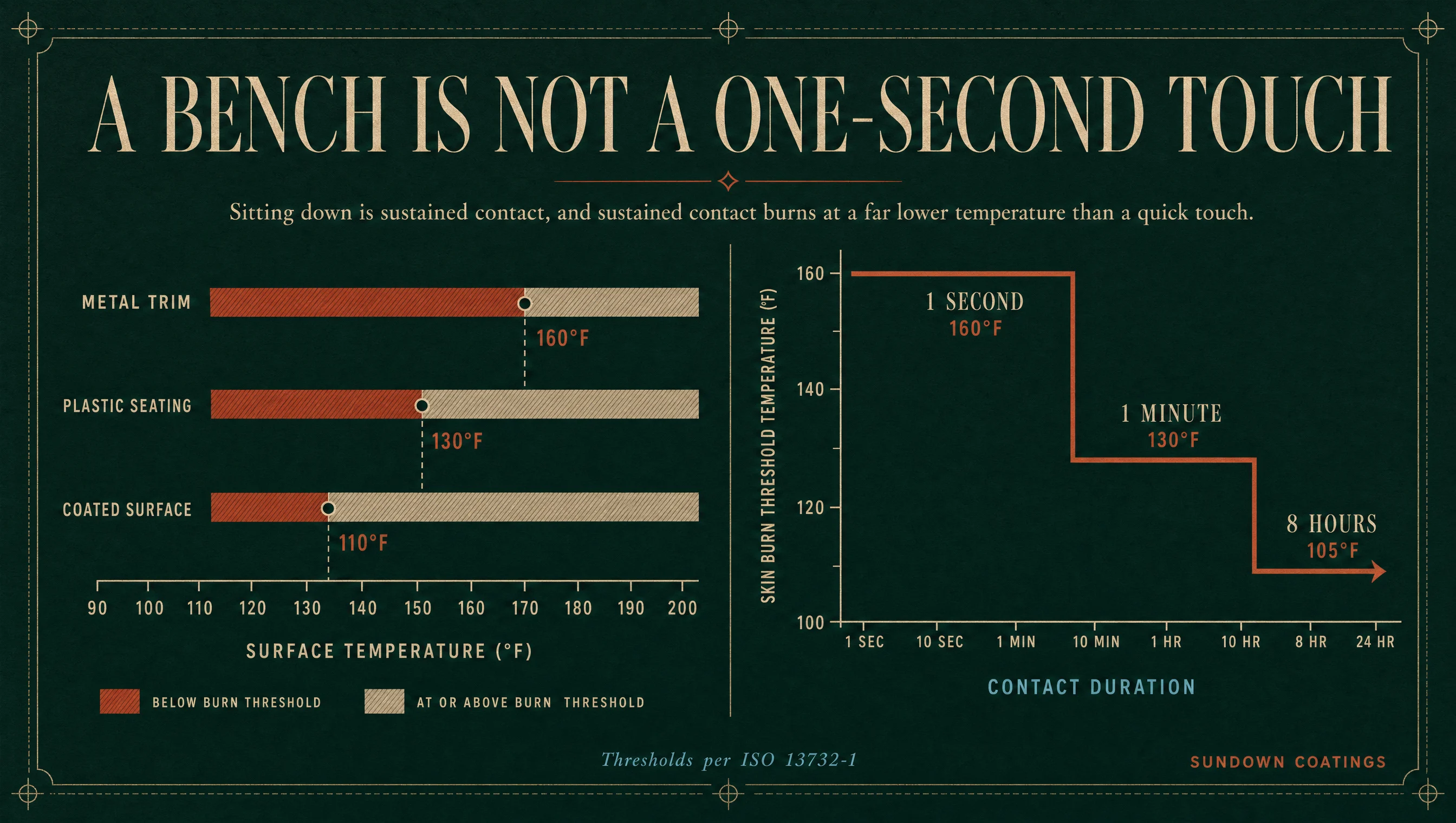
Contact temperature, not air temperature
A bench is not a one-second touch.

Why a coating changes it
Two numbers decide how hot a surface gets.
A dock bench and a roof are the same physics problem with a different consequence. Reflectance decides how much of the sun's energy the surface turns away on arrival. Emittance decides how fast the remainder leaves again instead of being held in the material. A dark, absorbent, low-emittance surface stores heat and gives it back to whatever touches it. That is the whole mechanism, and it is why colour and finish are not a cosmetic decision on something people sit on.
Published radiative split
Producer-published values. Match the stocked formula and batch before quoting a roof.
Published producer values, not a predicted surface result
Everything somebody touches
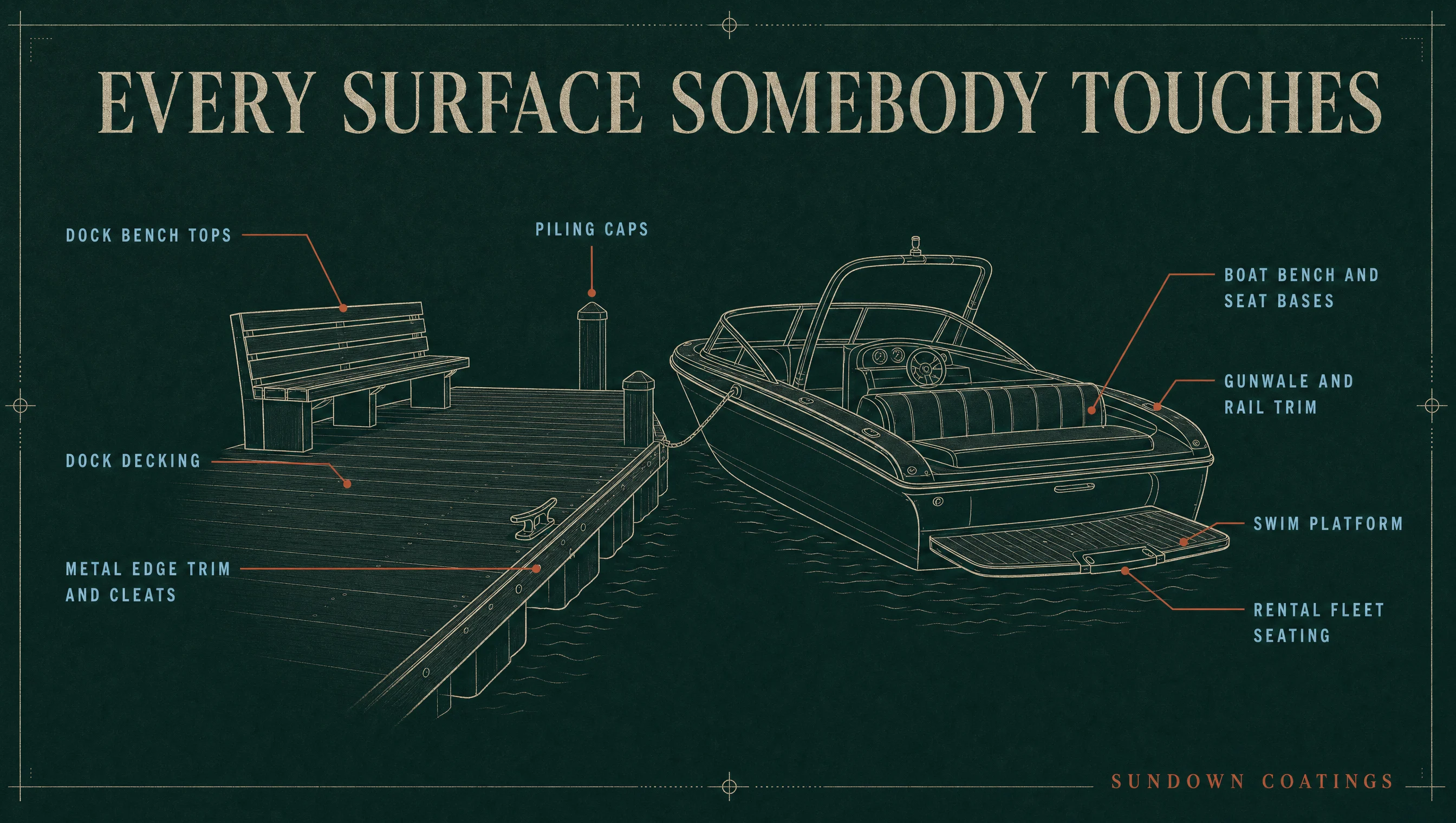
The job is a list of surfaces, not a boat.

- Dock decking: Composite, timber and previously coated dock surfaces that get walked on barefoot.
- Bench and seat tops: Fixed dock benches, boat bench seating and the moulded seat bases on rental craft.
- Metal trim and fittings: Cleats, edge trim, rails and aluminium framing — the surfaces that reach a burn threshold first.
- Rental fleet seating: Pedal boat shells, moulded plastic seating and the flat surfaces on a hire fleet that sit in sun all day.
- Swim platforms and steps: Horizontal surfaces people stand on wet and barefoot, which take the textured stucco-grade coat rather than the smooth one.
- Piling caps and structures: Exposed structural tops carrying continuous sun and thermal cycling.
The system is qualified against fiberglass, metal, aluminium, fibre cement, vinyl, previously coated surfaces and moulded plastics. Those do not share one preparation recipe, which is why the surfaces get identified before anything is specified. A hire fleet of twenty pedal boats and one timber dock is two specifications, not one.
Marine scope: Above the waterline. Never the hull bottom.. Fiberglass. Aluminium. Moulded plastic. Timber.. Smooth where you sit. Grit where you walk.. We publish what the surface reads at three years.
One portfolio, one mobilisation
The dock is already on the property you are quoting.
A large share of the parks and resort communities worth talking to already have water frontage, and with it a dock system, a rental fleet and structures living under the same sun as the roofs. Pricing that marina as a separate job is how it never gets done. Filed as part of the same portfolio audit, it moves on the same crew mobilisation, against the same specification, into the same closeout record. The park gets a visible amenity residents can feel on a Saturday, which is a different and easier conversation than deferred roof capital.
Salt, fuel, grip and the bridge
What is shown, what is claimed, and what we will not say.
This is the part a marine coating page normally skips. Salt is the hardest exposure there is and the first thing a marina operator should interrogate. Some of what follows is a product decision we make for you, some is documented in the producer literature but not yet evidenced here, and one item is outside what we sell. The distinction is the point.
Salt exposure qualification
Producer literature describes salt spray resistance tested to ASTM B117 past a thousand hours. That is the right standard and a strong figure, and it is why this vertical exists at all — but the report itself is not in hand here, so it is stated as something claimed rather than something shown. When the report lands with a named lab, product and substrate, this moves.
The Incheon Grand Bridge application
The formula owner's project files record a marine bridge application — salt air, every day, for years. We state that fact and stop there: no service life and no durability promise for your dock is derived from a bridge. Those are answered from your surfaces, measured.
Slip resistance is a product choice, not an assumption
There are two finishes. The smooth coat is for seating, trim and anything that is touched rather than walked on. The textured stucco-grade coat carries a grit you can hold a bare foot on and is what goes on decking, swim platforms and steps. Which one a surface gets is decided at specification, never left to the applicator, because a smooth reflective film on a wet dock is a hazard.
Fuel and petroleum resistance
Producer literature describes resistance to petroleum products, acids, alkalis and solvents, which is the difference between a fuel dock that stains and one that wipes. It is not yet backed here by a named report and exposure duration, so it sits in review with everything else in that state.
Immersion and antifouling
This is a system for surfaces above the waterline. Hull bottoms, anything continuously immersed and anything requiring antifouling are outside what is being offered.
Everything above moves out of this section the day a report exists. Until then it stays here, because a marina operator who finds out later that the salt claim was decoration is a customer nobody gets back.
Asked at the dock
The questions people actually ask.
- It changes how much solar energy the surface absorbs, which is what drives its temperature in the sun. It is not a guarantee of any particular surface temperature on your dock, because that depends on the material underneath, the colour it started, the air temperature, the wind and the hour. What the coating publishes is 0.88 initial solar reflectance and 0.89 thermal emittance, and 0.74 reflectance still reading at three years.
- Producer literature describes ASTM B117 salt spray testing past a thousand hours, which is the right standard and a strong number. We describe it as claimed rather than shown, because the report itself is not in our hands yet and we would rather say that than let you assume we have read it. Ask us again once it is, because it will be published here with the lab and the substrate named.
- Producer literature describes resistance to petroleum products, acids, alkalis and common solvents, which is the practical difference between a fuel dock that stains permanently and one that cleans up. Same caveat as the salt answer: it is documented in the product literature, and we have not yet put the underlying report in front of you.
- Not the one that goes on decking. There are two finishes: a smooth coat for seating, trim and anything you touch rather than walk on, and a textured stucco-grade coat carrying a grit you can hold a bare foot on, which is what goes on dock decking, swim platforms and steps. Which surface gets which is decided when the job is specified, not on the day by whoever has a roller.
- Above the waterline, on the substrates the system is qualified against, yes. Seating and trim take the smooth coat; anything walked on wet takes the textured one. They are two different specifications on the same boat, and that is normal.
- No. This is not an antifouling system and it is not for continuously immersed surfaces.
- It usually makes the whole thing easier. The dock structures, the rental fleet and the park's roofs are one portfolio, one specification and one crew mobilisation, which is a materially better deal than pricing the marina on its own.
Founding marine program
The first docks are the evidence.
There is no marine record yet, and the only way there is one is a first set of docks and fleets measured properly and published as they actually behave. Selected operators receive high-touch documentation and founding terms in exchange for scheduled surface readings, honest follow-up through a full season of sun and salt, and permission to publish the result — including if it disappoints.
File my dock or fleet

Free roof assessment